Choose a place for the flower, too
Stapelia gigantea
Stapelia has angular succulent stems and a large flower with a strong smell. Give it bright light, drainage and a position that works when it blooms.
The short answer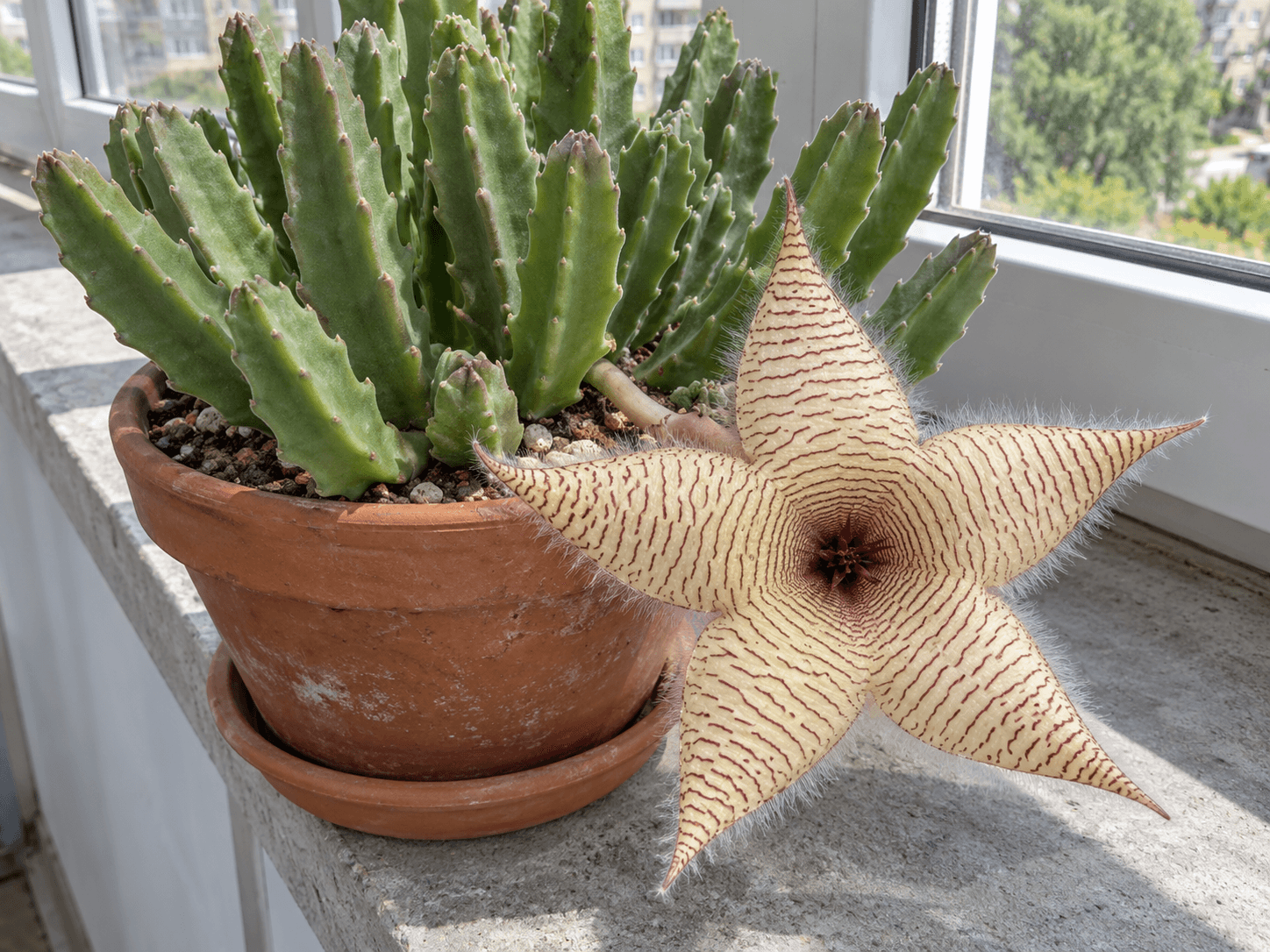
Angular stems, without cactus spines
Stapelia belongs to the dogbane family, Apocynaceae. Its succulent stems have four angles with small teeth along the ridges and a fine velvety surface. It is easy to call any upright succulent a cactus, but the botanical name is more useful when choosing care instructions.
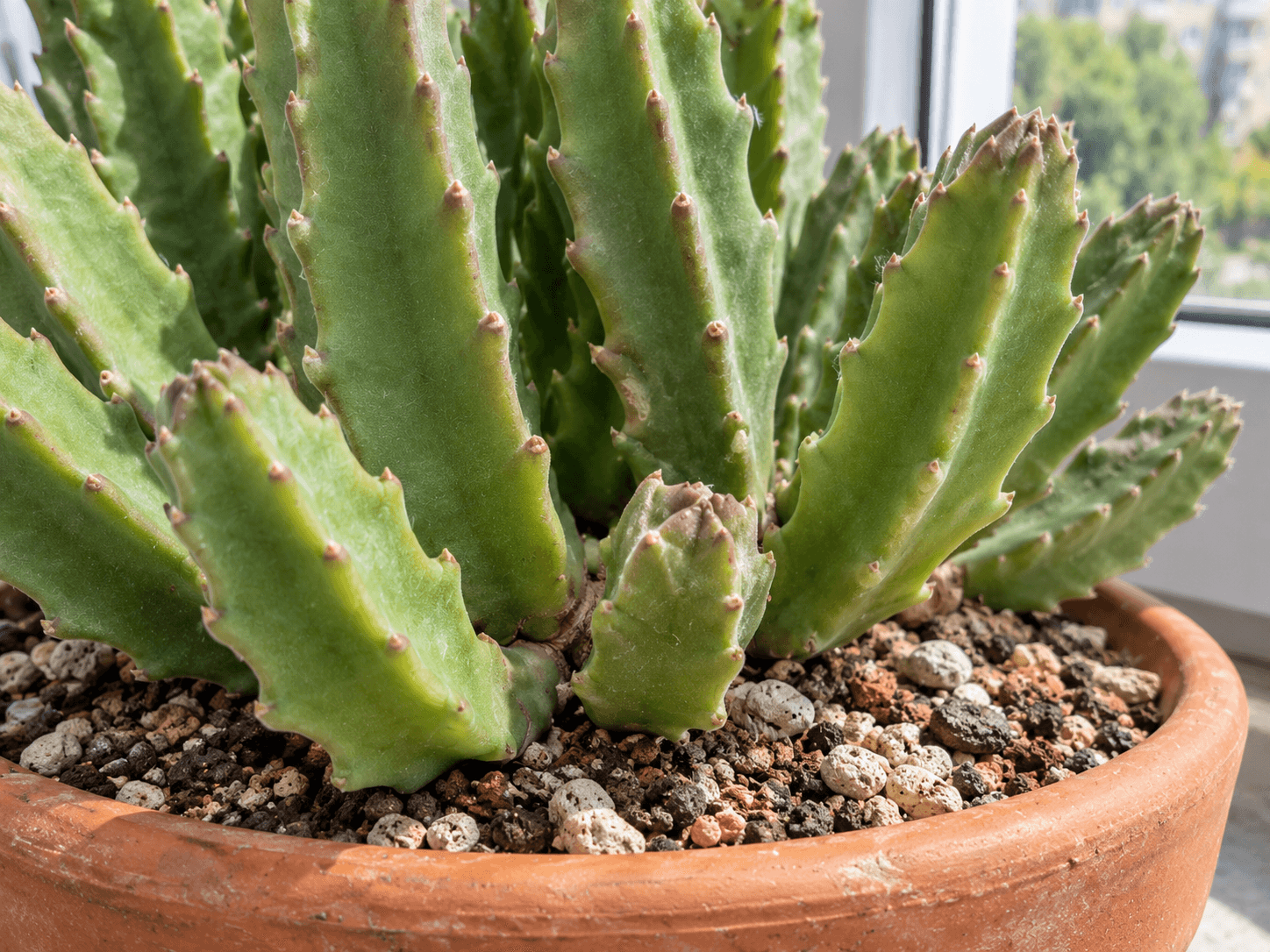
Keep the label if you buy a small non-flowering clump. Several stapeliads look similar before they flower. This profile concerns S. gigantea, whose large pale flowers have reddish transverse markings and hairy margins, rather than every plant sold as a starfish flower.
A bright place with room at the rim
Start with a bright window, acclimating a plant from a dim shop before exposing it to stronger sun. The RHS recommends full light with protection from hot sun under glass. Check the actual temperature at the sill rather than assuming that a succulent can tolerate any sunny indoor position.
Flowers develop near the base and may spread beyond the pot. Leave room for a bud to open without pressing against glass or another container. A low clump can be easy to overlook behind taller plants, so keep it accessible for checking both stems and mix.
Check the base before watering
- Feel the mix and lift the pot. Wait if the root zone is still damp, even when a stem looks wrinkled.
- When the mix has dried, water through the growing pot and let it drain completely.
- Empty the saucer or outer pot. Recheck the base for softness rather than adding repeated small top-ups.
Use a porous mix and a pot with drainage. In a cooler or slower-growing period, expect a longer interval between waterings.
Softening or deterioration at the base needs prompt inspection. Compare the condition of the mix and roots with that of the remaining firm stems. A large wet pot is not a useful rescue for a shrinking clump. Where healthy rooted sections remain, division is a possible way to preserve part of the plant.
Expect the smell
- Open flower, firm stems
- The carrion scent can come from the bloom. Leave room beyond the rim and choose a comfortable flowering spot.
- Soft base, wet mix
- Inspect promptly. Do not treat a collapsing stem as thirst or assume the flower explains it.
A schematic of S. gigantea, not a diagnostic photograph. Its large flower sits low beside the clump.
The carrion scent is part of the flower and attracts fly pollinators. It is not necessarily evidence that the potting mix has rotted. Check where the smell originates, especially when a large flower has just opened. Stem softness and wet deteriorating roots are separate observations.
A bright place away from a dining or sleeping area may be more comfortable during flowering. Keep the plant warm and frost-free if you relocate it. Putting a flowering tropical succulent outside on a cold Toronto evening simply exchanges one inconvenience for a plant problem.
Inspect a soft base or roots in persistently wet mixIf the clump grows but does not flower
Check whether the stems receive strong light rather than living behind a taller plant. Move a shade-grown clump toward brighter conditions gradually, with protection from hot sun under glass. Leave the low buds clear of the rim and nearby pots. There is no fixed indoor flowering date to promise, and extra watering will not make an unopened bud bloom.
Assess the light reaching the stemsFind a related guide below.
Back to the beginningSources & notes
Care guidance checked against these horticultural references on October 27, 2026.
- RHS: Stapelia giganteaAngled stems, flowering, bright protected light, draining mix and division.
- Singapore NParks: Stapelia giganteaFour-sided stems, shallow roots, dry-down and fly-attracting flowers.
- University of Maryland Extension: Watering indoor plantsMoisture and pot-weight checks; top and bottom watering.