Find the node first
Take a useful pothos cutting, keep leaves out of the rooting water and move an established cutting into a small draining pot.
The short answer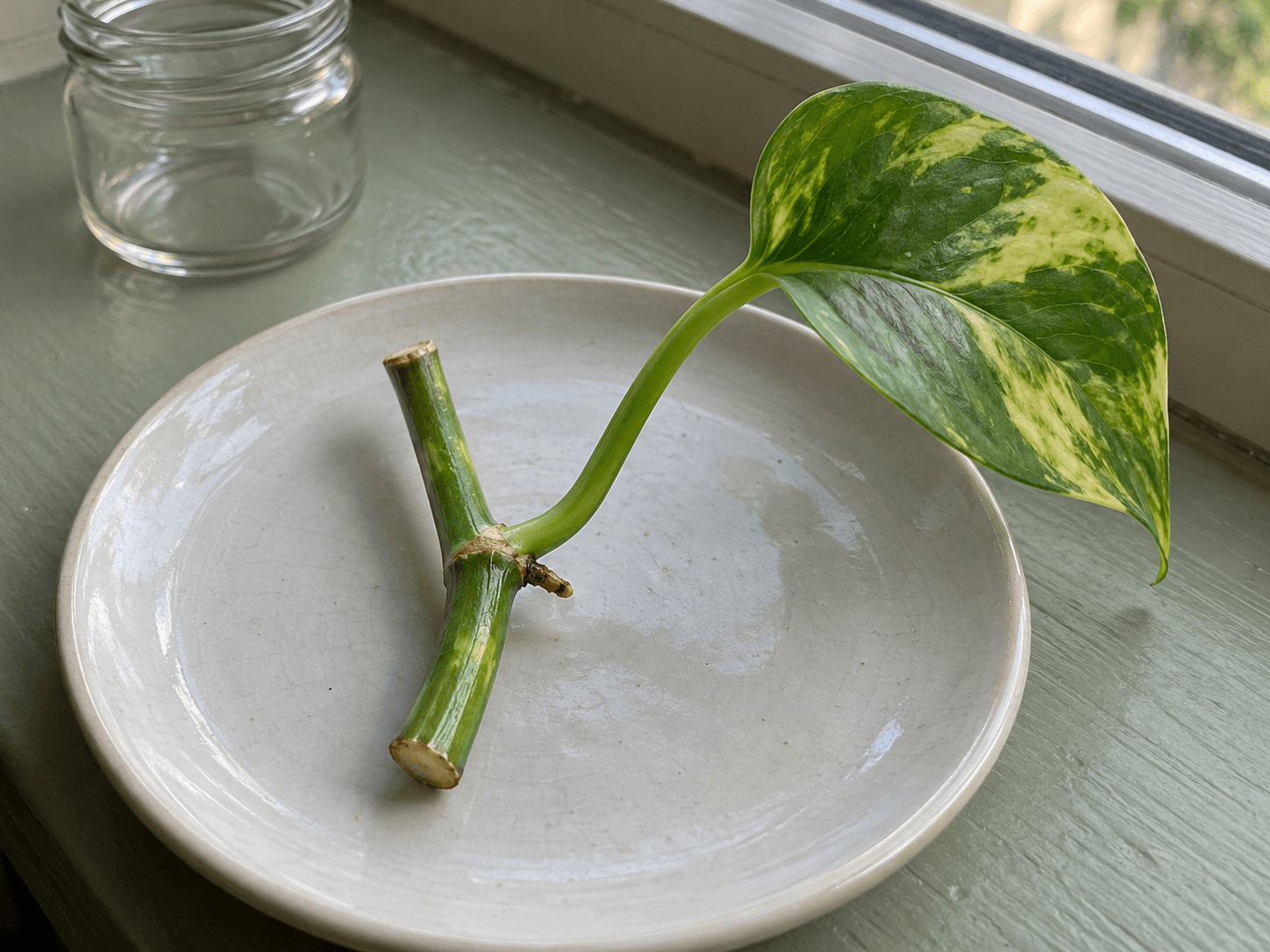
Know what you are cutting
Follow a vine to a point where a leaf joins the main stem. That junction is a node; a small aerial-root nub may be visible nearby. A leaf and its stalk without a piece of node-bearing stem are not the same thing as a useful pothos cutting.
Simplified anatomy. Root the node; keep the leaf above water or potting mix.
Choose healthy growth from a plant without a suspected pest problem. Propagation is not a way to pass an infestation to a friend. Decide which portion to remove before cutting so the parent plant keeps a shape you like.
Make a small, manageable cutting
- Use clean, sharp snips to cut below a node. A short piece with one or two healthy leaves is easy to manage.
- Remove any leaf that would sit under water or be buried in the rooting medium.
- Place the node in a clean vessel of water, keeping leaves above it, or use a suitable lightly moist propagation mix.
- Label the date and parent plant, then place the cutting in bright indirect light.
Keep the jar steady and out of reach of pets. Golden pothos is toxic if chewed. Use a small vessel you can inspect easily rather than a tall vase that hides the stem base.
Watch the stem as well as the roots
For a cutting in water, keep the node and developing roots submerged while the leaves stay above the surface. Replace the water once or twice a week, sooner if it becomes cloudy, and clean the vessel when needed. Remove a cutting whose stem turns soft or decays. For a cutting in mix, keep that small rooting area moist but draining; do not lift it out repeatedly to look for roots.
Rooting speed varies with plant health, light and temperature. Look for several healthy roots rather than relying on an exact number of days. A bright but cold winter sill can be an unhelpful combination. Keep the cutting clear of cold glass.
Move into a small pot
For a water-rooted cutting, several firm roots around 2.5 cm long or more are a useful point to transfer; it does not need to fill the jar. Make a hole in moist houseplant mix in a small draining pot, lower the roots in without folding them sharply, and cover the rooted node while keeping the leaves above the mix. Water to settle it and drain.
Keep the mix lightly moist during establishment rather than immediately giving the young plant the longer dry-down of an established vine. Check before watering so it is never left standing in runoff. A cutting rooted directly in a small pot can stay there while it establishes. When you give a plant away, include its identity, rooting date and the care conditions it has actually had.
Find a related guide below.
Back to the beginningSources & notes
Care guidance checked against these horticultural references on 20 October 2026.
- NC State Extension: Epipremnum aureumIdentity, light, pruning, rooting and ingestion risk.
- Iowa State University Extension: Propagating houseplantsSpecies-appropriate stem cuttings, divisions and plantlets.
- Iowa State University Extension: Stem tip cuttingsRoot development before potting, water changes and moist transition care.
- University of Minnesota Extension: Propagating Monstera deliciosaNodes, cuttings and rooting conditions.
- ASPCA: Golden pothosToxicity to cats and dogs; veterinary advice after suspected ingestion.